Climate Alarmism and Net Zero Strategy on the Wane
/While it has been clear to rational thinkers for some time that widespread climate alarmism is losing its impact, it took a recent pronouncement by Microsoft co-founder and philanthropist Bill Gates to inject a dose of much-needed reality into the climate debate. In a memo titled “Three tough truths about climate,” Gates declared that:
Climate change is a serious problem, but it will not be the end of civilization.
and,
Health and prosperity are the best defense against climate change.
Although as a skeptic, I disagree with Gates that global warming is largely the result of human activity, his memo is symbolic of the current move away from the highly exaggerated notion of a “climate crisis,” espoused by our leaders and the mainstream media. At the same time, the political drive toward the adoption of Net Zero policies is faltering in many countries.
Climate activists are being reined in too, at least Just Stop Oil protesters who have been jailed for disrupting UK motorways and airports, and defacing priceless pieces of art all over Europe. Their most recent efforts seem tame by comparison, such as the spraying of Stonehenge with an environmentally harmless orange powder that washes off.
The pied-piper-like campaign sparked by former Swedish schoolgirl Greta Thunberg has all but died, as Thunberg has diverted her activism to other issues like the war in the Gaza Strip. Her 2019 speech to the UN Climate Action Summit, in which she admonished the world for having “stolen my dreams and my childhood,” and claimed we are on the verge of a mass extinction with her accusatory “How dare you!”, is but a distant memory.
Even the UN Secretary-General is toning down his previously incendiary rhetoric on climate change. Just a few years after hysterically describing the IPCC (Intergovernmental Panel on Climate Change)’s Sixth Assessment Report as “code red for humanity” and proclaiming that “the era of global boiling has arrived,” all he could muster in his speech to the latest UN climate conference was a call for the gathering to “ignite a decade of acceleration and delivery.”
Along with the falloff in climate activism, the lemming-like drive by many governments toward Net Zero – the achievement of zero net CO2 emissions by 2050 – is losing steam. One of the reasons is the realization that surprisingly little global warming would actually be averted by adoption of Net-Zero policies. But nonscientific objections, especially the costs of implementing Net Zero, are gaining increasing attention as well.
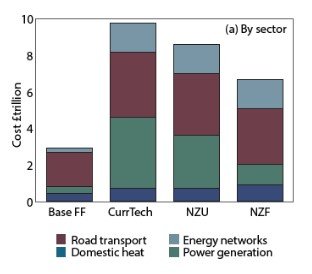
Discussion of likely costs is most advanced in the UK, which was the first major economy to establish a legally binding Net-Zero target in 2019. Estimates of total cost vary wildly, but most are in the range of £1-10 trillion ($1.3-13 trillion), as shown in the figure below based on various scenarios. A total of £3 trillion ($3.9 trillion) would be equivalent to an unacceptable £100,000 ($130,000) per household, according to a recent report.
The enormous cost of Net Zero is reflected in the cost of electricity – a driving force in the economy and of particular concern to electricity users, both industrial and domestic. The next figure illustrates the average cost of electricity over the last 30 years in both the UK and U.S. While the U.S. cost has remained level during that period, the UK cost has soared, prompting fears of the nation committing economic suicide by bankrupting industrial users.
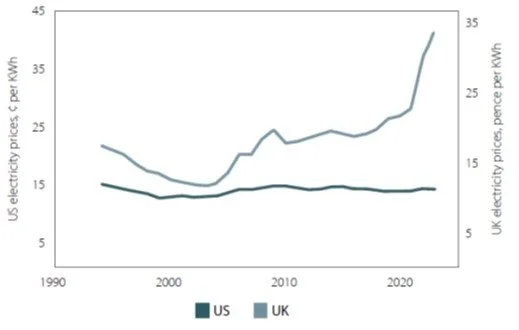
The marked difference can be attributed entirely to the UK’s quest for Net Zero, founded on intermittent and unreliable renewable energy which provided 51% of the country’s electricity in 2024. In the U.S., cooler heads have prevailed and only 21% of electricity generation was from renewable sources in 2023. However, the wheel may be turning as the UK and other European countries previously dedicated to Net Zero are having second thoughts.
A major concern all over the UK and EU is potential deindustrialization, the viability of industry being heavily dependent on electricity costs. The UK currently has the highest industrial electricity prices in the developed world. Numerous manufacturers of automobiles, steel and other products have already pulled up their British roots and moved to countries where electricity (and labor) is cheaper or simply gone out of business altogether. Germany, where the cost of electricity has also risen steeply, is also struggling to keep its economy afloat.
Meanwhile, China and India – the largest and 3rd largest emitters of CO2, respectively – are all but ignoring Net Zero. India has a Net-Zero goal of 2070, while China has not set any goal at all.
China currently leads the world in building new coal-fired power plants, construction of which reached a 10-year high in 2024; at the same time, renewables contributed 32% of the country’s electricity that year. India burns less coal than China but still relies heavily on coal for electricity generation.
Next: No U.S. Landfalling Hurricanes in 2025 Refutes Alarmist Rhetoric on Weather Extremes