Ongoing Attacks on Livestock Methane Emissions Based on Faulty Science
/Farmers around the world have become a scapegoat for global warming, based on the assumption that emissions of methane (CH4) from ruminant animals trap far more heat than carbon dioxide (CO2) over shorter timeframes.
However, despite the ongoing attacks on agriculture, this assumption is wrong and stems from a fundamental misunderstanding of the underlying science. Methane is indeed a potent greenhouse gas but, because its atmospheric concentration is increasing at a negligible rate compared with that of CO2, its contribution to global warming is small in comparison.
Let me explain. As I discussed in a 2023 post, the actual warming produced by a greenhouse gas depends on its so-called “global warming potential” – a quantity determined by how efficiently the gas absorbs heat, its lifetime in the atmosphere, and its atmospheric concentration.
The conventional global warming potential (GWP) is a dimensionless metric, created by the UN’s IPCC (Intergovernmental Panel on Climate Change), in which the GWP per molecule of a particular greenhouse gas is normalized to that of CO2; the GWP takes into account the atmospheric lifetime of the gas. The following table shows both GWP-20 and GWP-100, the warming potentials calculated over a 20-year and 100-year time horizon, respectively, for both CO2 and CH4.

The GWP value for CH4 over 20 years suggests, erroneously, that CH4is a whopping 83 times more potent than CO2 as a greenhouse gas. It’s this number that has been used by climate alarmists to demonize farmers and their livestock.
Farmers caught something of a break when a group of physicists at the University of Oxford realized that the IPCC’s GWP can overestimate the warming effect of short-lived greenhouse gases such as CH4, compared to longer-lived gases like CO2. The Oxford researchers proposed replacing the GWP with a metric called GWP*, in which the CO2-equivalence of short-lived greenhouse gas emissions is determined predominantly by changes in emission rate.
Nevertheless, even though using GWP* leads to smaller estimates of CH4’s contribution to warming, the estimates are still too high because both the GWP and GWP* fail to account for the relative rate of concentration increase for CH4 compared with CO2.
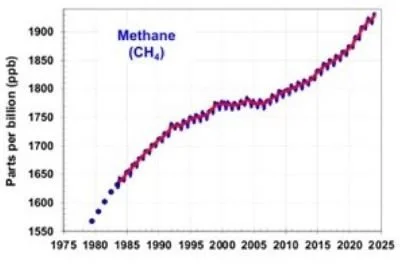
The yearly abundance of CH4 in the atmosphere since 1980, as measured by NOAA (the U.S. National Oceanic and Atmospheric Administration), is depicted in the next figure. Currently, the global average CH4 concentration is approaching 1.95 ppm (1950 ppb), more than two orders of magnitude lower than the CO2 level of approximately 420 ppm. The rate of increase in the CH4 level over the last 10 years averages about 0.011 ppm (11 ppb) per year, which is approximately 225 times smaller than the average rate of increase in the CO2 level of around 2.5 ppm per year.
Including this data in the GWP calculation means that the contribution of CH4 to global warming is only 83/225 that of CO2 over 20 years or 30/225 over 100 years. These values of what I’ve designated “True GWP” are shown as percentages in the table below, which is an extension of the previous table above.
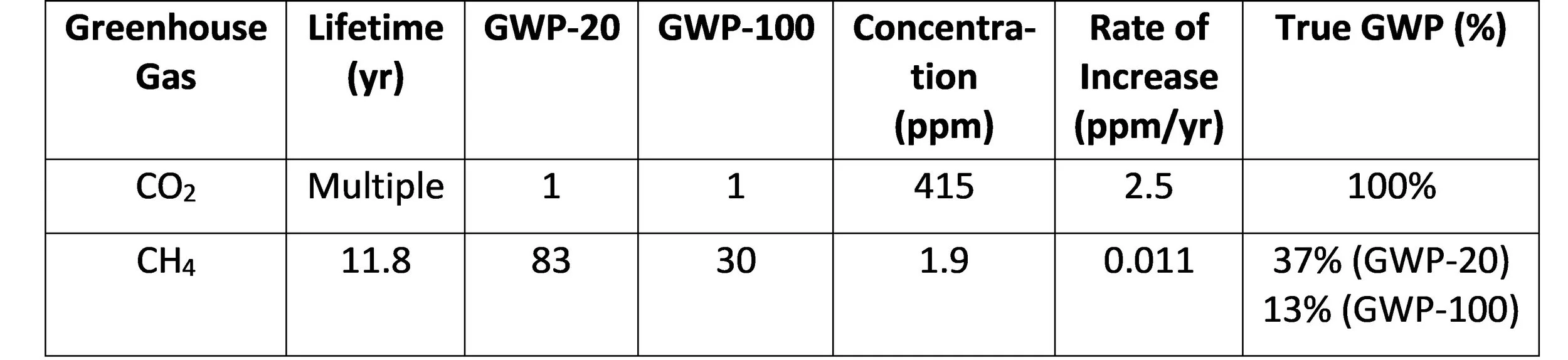
So CH4 is only 37% (0.37) as potent a greenhouse gas as CO2 over 20 years – a far cry from the 83 times as potent number promoted by climate activists and the mainstream media.
Farmers, sensing that official pronouncements on the warming effect of CH4 are exaggerated, even without this revelation about True GWP, have begun to push back. At the II World Congress on Sustainable Livestock in Extremadura, Spain in November 2025, an international group of livestock farmers and producers came together to highlight “the true environmental sustainability of livestock farming based on the latest climate science,” emphasizing that it has supported human civilization for millennia.
At the Congress, New Zealand farmer and former parliamentarian Owen Jennings briefly discussed the misuse of GWP and GWP*, adding that: Much of the science relating to ruminant methane emissions is plain wrong. IPCC claims have been found to be outdated and erroneous. Curtailing methane is distracting, expensive and unnecessary.
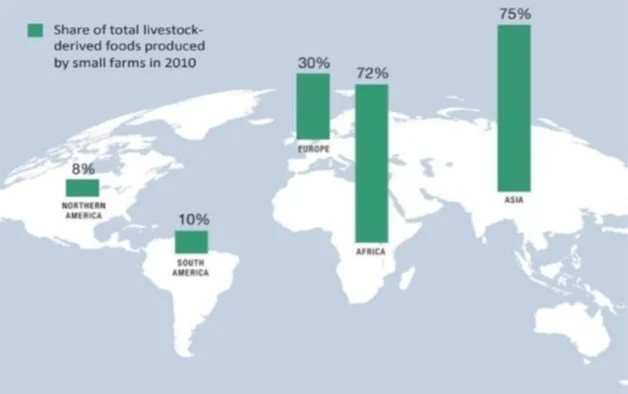
Another speaker pointed out that small farms of less than 20 hectares (50 acres) provide more than 50 % of the world’s livestock, with more than 70% in emerging and developing economies, as illustrated in the figure below. Anti-livestock journalism, based in part on a misunderstanding of ruminant CH4’s minimal contribution to current warming, is far more of a threat to these farms than climate change itself.
Next: Southern Ocean Cooling: Climate Scientists Unable to Agree on Explanation