RIP RCP8.5: A Hopeful Sign That the Attack on Science Is Letting Up
/Nowhere is the attack on science more evident than in the debate over the human contribution to current global warming. But the recent publication of brand-new 2026 emissions scenarios that finally killed off the older RCP8.5 – which was behind the highly exaggerated notion of a “climate crisis” and other alarmist proclamations – raises hopes that reason may be returning to science.
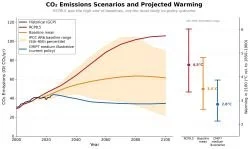
The introduction of RCP8.5 in the early 2010s was probably well-intentioned. As the highest of standard low-, medium- and high-emissions pathways created by climate scientists, RCP8.5 anticipated annual CO2 emissions roughly tripling by 2100, as seen in the figure below. Even though this was unlikely, it was included as part of an effort to capture all supposedly plausible outcomes – a worst case scenario around the 90th percentile.
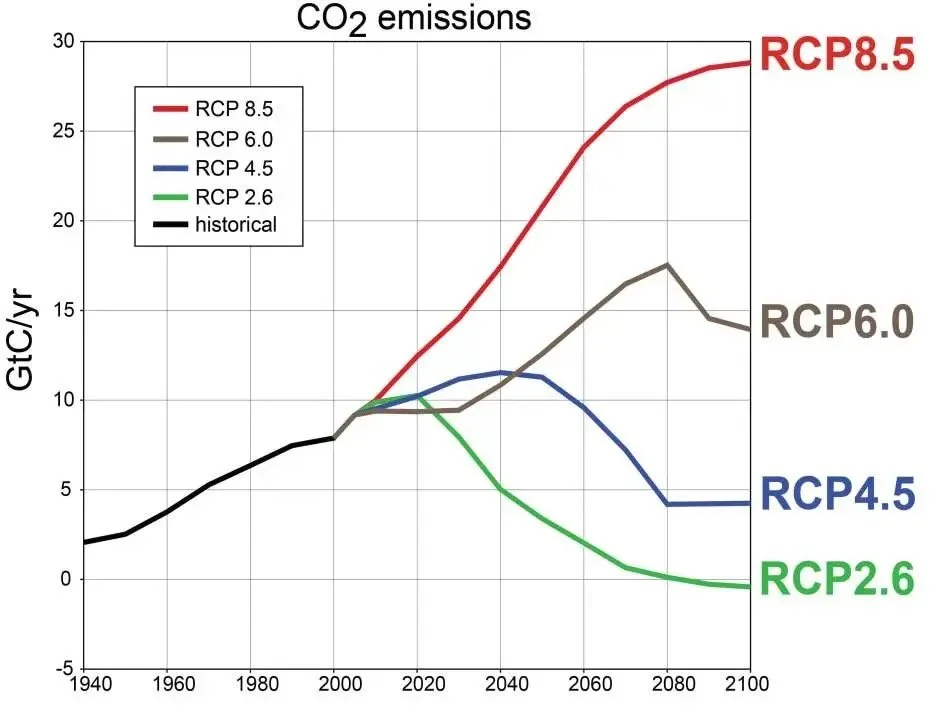
But RCP8.5 quickly became adopted by climate alarmists and many in the climate science community as a “business as usual” scenario, which assumed emissions were on an ever-increasing trajectory. It ignored true science that was reflected in the lower emissions pathways.
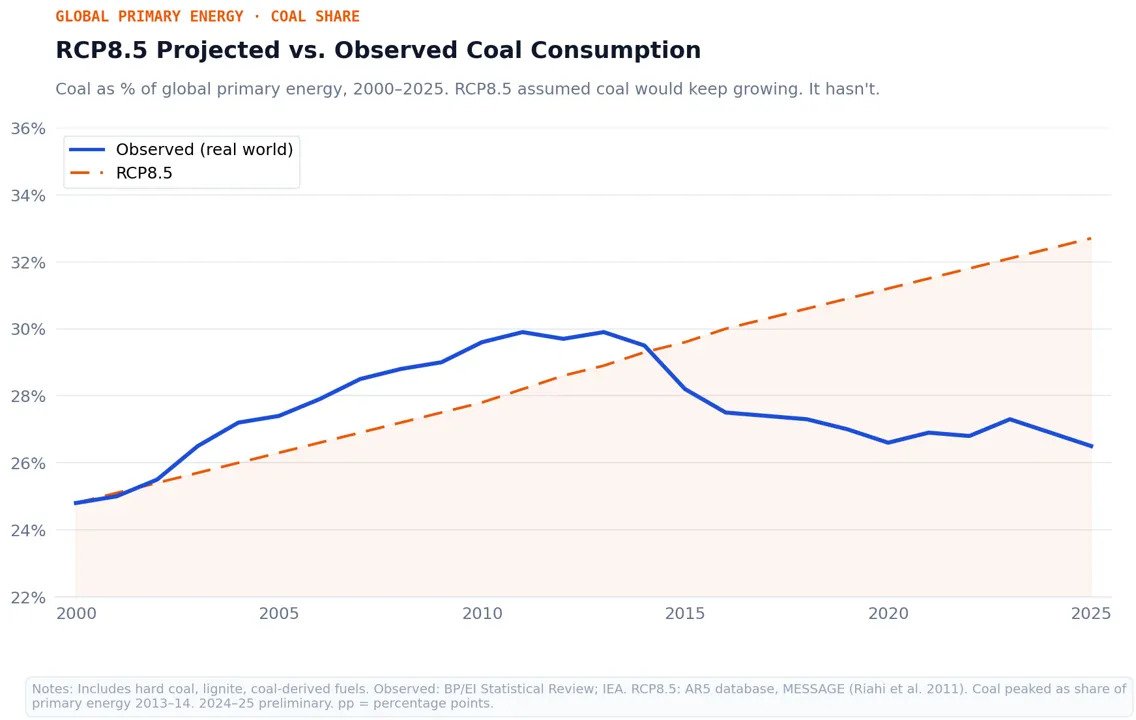
That RCP8.5 was in fact implausible is evident in its underlying assumptions. First, the scenario predicted a five to sevenfold increase in global coal use that included fueling cars with coal-based liquids, displacing gasoline. As climate writer Roger Pielke Jr. has pointed out, the scenario extrapolated then rapidly rising coal growth rates in China and assumed that such vast amounts of coal would still be available by the end of the century, regardless of geological reality or other real-world constraints.
The next figure shows that actual coal use started to decline as early as 2015. The dashed line depicts the erroneous, steadily increasing projection of RCP8.5, a false assumption baked into the scenario from the outset.
Another implausible assumption in RCP8.5 was massive population growth, from approximately 7 billion in 2010 to between 11 and 12 billion by 2100. Combined with purported high energy demand and slow income growth, as well as scorching heat, the assumed population gain would result in a lowering of global GDP. However, current demographic models peg the global population at under 10.4 billion by 2080, and socioeconomic trends suggest a much more prosperous world with substantial gains in GDP by then.
A third mistaken assumption behind RCP8.5 was future stagnation in improvements to non-coal technologies such as solar, wind and nuclear power, due to the dominance of coal energy. That hasn’t happened either, with major strides in all three areas.
The figure below compares CO2 emissions and projected warming between 2000 and 2100 for three different pathways: the now obsolete RCP8.5; the mean of the baseline scenarios published by the IPCC (Intergovernmental Panel on Climate Change) in its Sixth Assessment Report; and one of the new 2026 scenarios. As can be seen, projected 2100 global warming falls from 4.5 degrees Celsius (8.1 degrees Fahrenheit) in RCP 8.5 to 2.8 degrees Celsius (5.0 degrees Fahrenheit) in the latest representation.
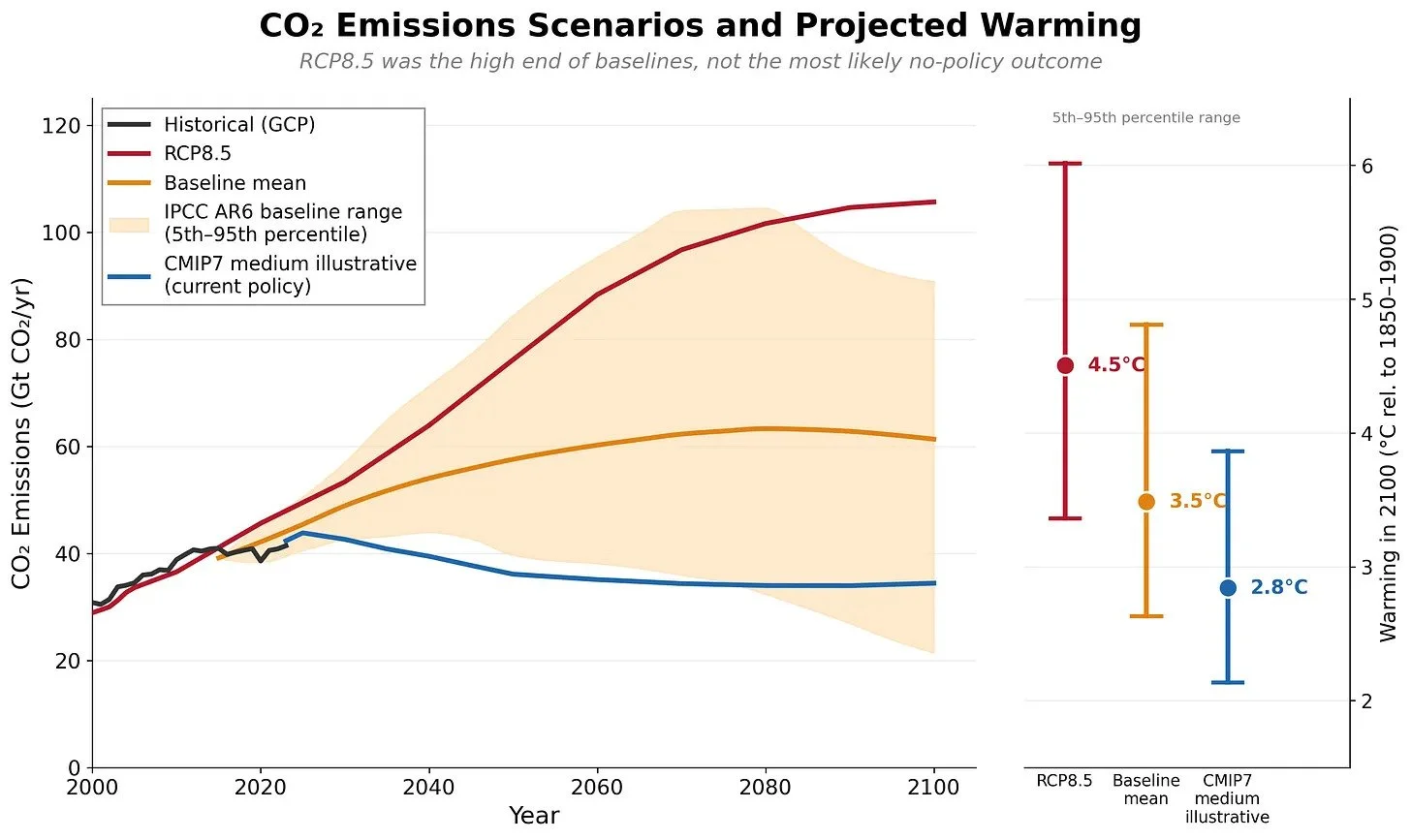
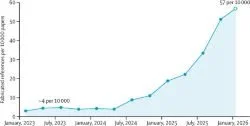
The widespread adoption of RCP8.5 greatly distorted the climate change debate. Hundreds if not thousands of published research papers and government reports that assumed RCP8.5 was realistic took the underlying science in an entirely wrong direction, by coming up with results or predictions that must now be regarded with suspicion.
On the policy side, central banks used it to test whether financial institutions were prepared for the effects of climate change – effects that RCP8.5 exaggerated. Governments around the world used it for adaptation planning, and insurance companies used it to set rates. A whole host of past actions now need to be reexamined in the light of the new emissions scenarios.
But perhaps the greatest damage was to the public perception of climate change. Fed by media hype, people were persuaded that not only was global warming man-made and dangerous, but we were also in a climate crisis. The UN secretary-general was among many duped leaders, hysterically describing the IPCC’s Sixth Assessment Report as “code red for humanity” and proclaiming that “the era of global boiling has arrived.”
Some, like Roger Pielke Jr. and his colleague Justin Ritchie, were not fooled and began questioning conventional wisdom and arguing against the continued use of RCP8.5 almost 10 years ago. Yet these early voices of reason were largely dismissed until now. That’s a sad reflection on the state of science today.
But, as I said at the outset, this major body blow to climate alarmism may represent a turning point in the ongoing attack on science.
Next: The Pseudoscience behind Extreme Weather Attribution