No Evidence That Climate Change Causes Weather Extremes: (1) Drought

Weather extremes are a commonly cited line of evidence for human-caused climate change. Despite the UN’s IPCC (Intergovernmental Panel on Climate Change) having found little to no evidence that global warming triggers extreme weather, the mainstream media and more than a few climate scientists don’t hesitate to trumpet their beliefs to the contrary at every opportunity.

In this and subsequent blog posts, I’ll show how the quasi-religious belief linking extreme weather events to climate change is badly mistaken and at odds with the actual scientific record. We’ll start with drought.

Droughts have been a continuing feature of the earth’s climate for millennia. Although generally caused by a severe fall-off in precipitation, droughts can be aggravated by other factors such as elevated temperatures, soil erosion and overuse of available groundwater. The consequences of drought, which can be catastrophic for human and animal life, include crop failure, starvation and mass migration. A major exodus of early humans out of Africa about 135,000 years ago is thought to have been driven by drought.  

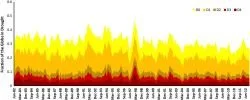
Getting a good handle on drought has only been possible since the end of the 19th century, when the instrumentation needed to measure extreme weather accurately was first developed. The most widely used gauge of dry conditions is the Palmer Drought Severity Index that measures both dryness and wetness and classifies them as “moderate”, “severe” or “extreme.” The figure below depicts the Palmer Index for the U.S. during the past century or so, for all three drought or wetness classifications combined.

US drought index 1900-2012 JPG.jpg

What jumps out immediately is the lack of any long-term trend in either dryness or wetness in the U.S. With the exception of the 1930s Dust Bowl years, the pattern of drought (upper graph) looks boringly similar over the entire 112-year period, as does the pattern of excessive rain (lower graph).

Much the same is true for the rest of the world. The next figure illustrates two different drought indices during the period 1910-2010 for India, a country subject to parching summer heat followed by drenching monsoonal rains; negative values denote drought and positive values wetness. The two indices are a version of the Palmer Drought Severity Index (sc-PDSI, top graph), and the Standardized Precipitation Index (SPI, bottom graph). The SPI, which relies on rainfall data only, is easier to calculate than the PDSI, which depends on both rainfall and temperature. While both indices are useful, the SPI is better suited to making comparisons between different regions.

India Drought Index

1910-2010

SPEI index India JPG TOP.jpg
SPEI index India JPG BOTTOM.jpg

You’ll see that the SPI in India shows no particular tendency over the 100-year period toward either dryness or wetness, though there are 20-year intervals exhibiting one of the two conditions; the apparent trend of the PDSI toward drought since 1990 is an artifact of the index. Similar records for other countries around the globe all show the same thing – no drying of the planet as a whole over more than 100 years.

Recently, the mainstream media created false alarm over drought by mindlessly broadcasting the results of a new study, purporting to demonstrate that global warming will soon result in “unprecedented drying.” By combining computer models with long-term observations, the study authors claim to have definitively connected global warming to drought.

But this claim doesn’t hold up, even in the study’s results. Although the authors were able to match warming to drought conditions during the first half of the 20th century, their efforts were a dismal failure after that. From 1950 to 1980, the “fingerprint” of human-caused global warming completely disappeared, in spite of ever-increasing CO2 in the atmosphere. And from 1981 onward, the fingerprint was so faint that it couldn’t be distinguished from background noise. So the assertion by the authors that global warming causes drought is nothing but wishful thinking.

As further evidence that climate change isn’t exacerbating drought, the final figure below shows the Palmer Index for the U.S. since 1996. Just like the record for the period from 1900 up to 2012 illustrated in the first figure above, there is no discernible trend in either dryness or wetness. While the West and Southwest have both experienced lengthy spells of drought during this period, extreme dry conditions now appear to have abated in both Texas and California.

US drought index 1996-2018 JPG.jpg

In summary, the scientific evidence simply doesn’t support any link between drought and climate change. The IPCC was right to express low confidence in any global-scale observed trend.

Next: No Evidence That Climate Change Causes Weather Extremes: (2) Floods

Science, Political Correctness and the Great Barrier Reef

A recent Australian court case highlights the intrusion of political correctness into science to bolster the climate change narrative. On April 16, a federal judge ruled that Australian coral scientist Dr. Peter Ridd had been unlawfully fired from his position at North Queensland’s James Cook University, for questioning his colleagues’ research on the impact of climate change on the Great Barrier Reef. In his ruling, the judge criticized the university for not respecting Ridd’s academic freedom.

Great Barrier Reef.jpg

The Great Barrier Reef is the world's largest coral reef system, 2,300 km (1,400 miles) long and visible from outer space. Labeled by CNN as one of the seven natural wonders of the world, the reef is a constant delight to tourists, who can view the colorful corals from a glass-bottomed boat or by snorkeling or scuba diving.

Rising temperatures, especially during the prolonged El Niño of 2014-17, have severely damaged portions of the Great Barrier Reef – so much so that the reef has become the poster child for global warming. Corals are susceptible to overheating and undergo bleaching when the water gets too hot, losing their vibrant colors. But exactly how much of the Great Barrier Reef has been affected, and how quickly it’s likely to recover, are controversial issues among reef researchers.

Ridd’s downfall came after he authored a chapter on the resilience of Great Barrier Reef corals in the book, Climate Change: The Facts 2017. In his chapter and subsequent TV interviews, Ridd bucked the politically correct view that the reef is doomed to an imminent death by climate change, and criticized the work of colleagues at the university’s Centre of Excellence for Coral Reef Studies. He maintained that his colleagues’ findings on the health of the reef in a warming climate were flawed, and that scientific organizations such as the Centre of Excellence could no longer be trusted.

Ridd had previously been censured by the university for going public with a dispute over a different aspect of reef health. This time, his employer accused Ridd of “uncollegial” academic misconduct and warned him to remain silent about the charge. When he didn’t, the university fired him after a successful career of more than 40 years.

At the crux of the issue of bleaching is whether or not it’s a new phenomenon. The politically correct view of many of Ridd’s fellow reef scientists is that bleaching didn’t start until the 1980s as global warming surged, so is an entirely man-made spectacle. But Ridd points to scientific records that reveal multiple coral bleaching events around the globe throughout the 20th century.

The fired scientist also disagrees with his colleagues over the extent of bleaching from the massive 2014-17 El Niño. Ridd estimates that just 8% of Great Barrier Reef coral actually died; much of the southern end of the reef didn’t suffer at all. But his politically correct peers maintain that the die-off was anywhere from 30% to 95%.

Such high estimates, however, are for very shallow water coral – less than 2 meters (7 feet) below the surface, which is only a small fraction of all the coral in the reef. A recent independent study found that deep water coral – down to depths of more than 40 meters (130 feet) – saw far less bleaching. And while Ridd’s critics claim that warming has reduced the growth rate of new coral by 15%, he finds that the growth rate has increased slightly over the past 100 years.

Ridd explains the adaptability of corals to heating as a survival mechanism, in which the multitude of polyps that constitute a coral exchange the microscopic algae that normally live inside the polyps and give coral its striking colors. Hotter than normal water causes the algae to poison the coral that then expels them, turning the polyps white. But to survive, the coral needs resident algae which supply it with energy by photosynthesis of sunlight. So from the surrounding water, the coral selects a different species of algae better suited to hot conditions, a process that enables the coral to recover within a few years, says Ridd.

Ridd attributes what he believes are the erroneous conclusions of his reef scientist colleagues to a failure of the peer review process in scrutinizing their work. To support his argument, he cites the so-called reproducibility crisis in contemporary science – the vast number of peer-reviewed studies that can’t be replicated in subsequent investigations and whose findings turn out to be false. Although it’s not known how severe irreproducibility is in climate science, it’s a serious problem in the biomedical sciences, where as many as 89% of published results in certain fields can’t be reproduced.

In Ridd’s opinion, as well as mine, studies predicting that the Great Barrier Reef is in imminent peril are based more on political correctness than good science.

Next: UN Species Extinction Report Spouts Unscientific Hype, Dubious Math

Does Climate Change Threaten National Security?

Earth new.jpg

The U.S. White House’s proposed Presidential Committee on Climate Security (PCCS) is under attack – by the mainstream media, Democrats in Congress and military retirees, among others. The committee’s intended purpose is to conduct a genuine scientific assessment of climate change.

But the assailants’ claim that the PCCS is a politically motivated attempt to overthrow science has it backwards. The Presidential Committee will undertake a scientifically motivated review of climate change science, in the hope of eliminating the subversive politics that have taken over the scientific debate.

It’s those opposed to the committee who are playing politics and abusing science. The whole political narrative about greenhouse gases and dangerous anthropogenic (human-caused) warming, including the misguided Paris Agreement that the U.S. has withdrawn from, depends on faulty computer climate models that failed to predict the recent slowdown in global warming, among other shortcomings. The actual empirical evidence for a substantial human contribution to global warming is flimsy.

And the supposed 97% consensus among climate scientists that global warming is largely man-made is a gross exaggeration, mindlessly repeated by politicians and the media.

The 97% number comes primarily from a study of approximately 12,000 abstracts of research papers on climate science over a 20-year period. What is rarely revealed is that nearly 8,000 of the abstracts expressed no opinion at all on human-caused warming. When that and a subsidiary survey are taken into account, the climate scientist consensus percentage falls to between 33% and 63% only. So much for an overwhelming majority! 

Blatant exaggeration like this for political purposes is all too common in climate science. An example that permeates current news articles and official reports on climate change is the hysteria over extreme weather. Almost every hurricane, major flood, drought, wildfire or heat wave is ascribed to global warming.

But careful examination of the actual scientific data shows that if there’s a trend in any of these events, it’s downward rather than upward. Even the UN’s Intergovernmental Panel on Climate Change has found little to no evidence that global warming increases the occurrence of many types of extreme weather.

Polar bear JPG 250.jpg

Another over-hyped assertion about climate change is that the polar bear population at the North Pole is shrinking because of diminishing sea ice in the Arctic, and that the bears are facing extinction. Yet, despite numerous articles in the media and photos of apparently starving bears, current evidence shows that the polar bear population has actually been steady for the whole period that the ice has been decreasing and may even be growing, according to the native Inuit.

All these exaggerations falsely bolster the case for taking immediate action to combat climate change, supposedly by pulling back on fossil fuel use. But the mandate of the PCCS is to cut through the hype and assess just what the science actually says.  

A specific PCCS goal is to examine whether climate change impacts U.S. national security, a connection that the defense and national security agencies have strongly endorsed.

A recent letter of protest to the President from a group of former military and civilian national security professionals expresses their deep concern about “second-guessing the scientific sources used to assess the threat … posed by climate change.” The PCCS will re-evaluate the criteria employed by the national agencies to link national security to climate change.

The protest letter also claims that less than 0.2% of peer-reviewed climate science papers dispute that climate change is driven by humans. This is nonsense. In solar science alone during the first half of 2017, the number of peer-reviewed papers affirming a strong link between the sun and our climate, independent of human activity, represented approximately 4% of all climate science papers during that time – and there are many other fields of study apart from the sun.

Let’s hope that formation of the new committee will not be thwarted and that it will uncover other truths about climate science.

(This post was published previously on March 7, on The Post & Email blog.)

Next: Measles Rampant Again, Thanks to Anti-Vaccinationists