No Evidence That Weather Extremes Becoming More Frequent or Intense: (4) Hurricanes and Typhoons
/This fourth post in our series on the spurious links between climate change and extreme weather examines the incidence of hurricanes and typhoons – powerful tropical cyclones that cause devastation around the globe and have claimed hundreds of thousands of lives. But, contrary to public opinion, hurricanes and typhoons show a decreasing trend worldwide, and their landfalling frequency has not changed for at least 50 years.
Hurricanes are classified by their sustained wind speeds on the Saffir-Simpson scale, ranging from Category 1, the weakest, to Category 5, the strongest. A major hurricane is defined as one in Category 3, 4 or 5, corresponding to a top wind speed of 178 km per hour (111 mph) or greater. Hurricanes occur in the Atlantic and northeastern Pacific Oceans, especially in and around the Gulf of Mexico; their cousins, typhoons, occur in the northwestern Pacific.
Hurricanes can be hundreds of kilometers in extent, with wind speeds up to 240 km per hour (150 mph) or more and often exact a heavy toll in human lives and personal property. The deadliest U.S. hurricane in recorded history struck Galveston, Texas in 1900, killing an estimated 8,000 to 12,000 people. In the Caribbean, the Great Hurricane of 1780 killed 27,500 and winds exceeded an estimated 320 km per hour (200 mph).
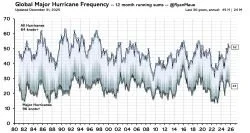
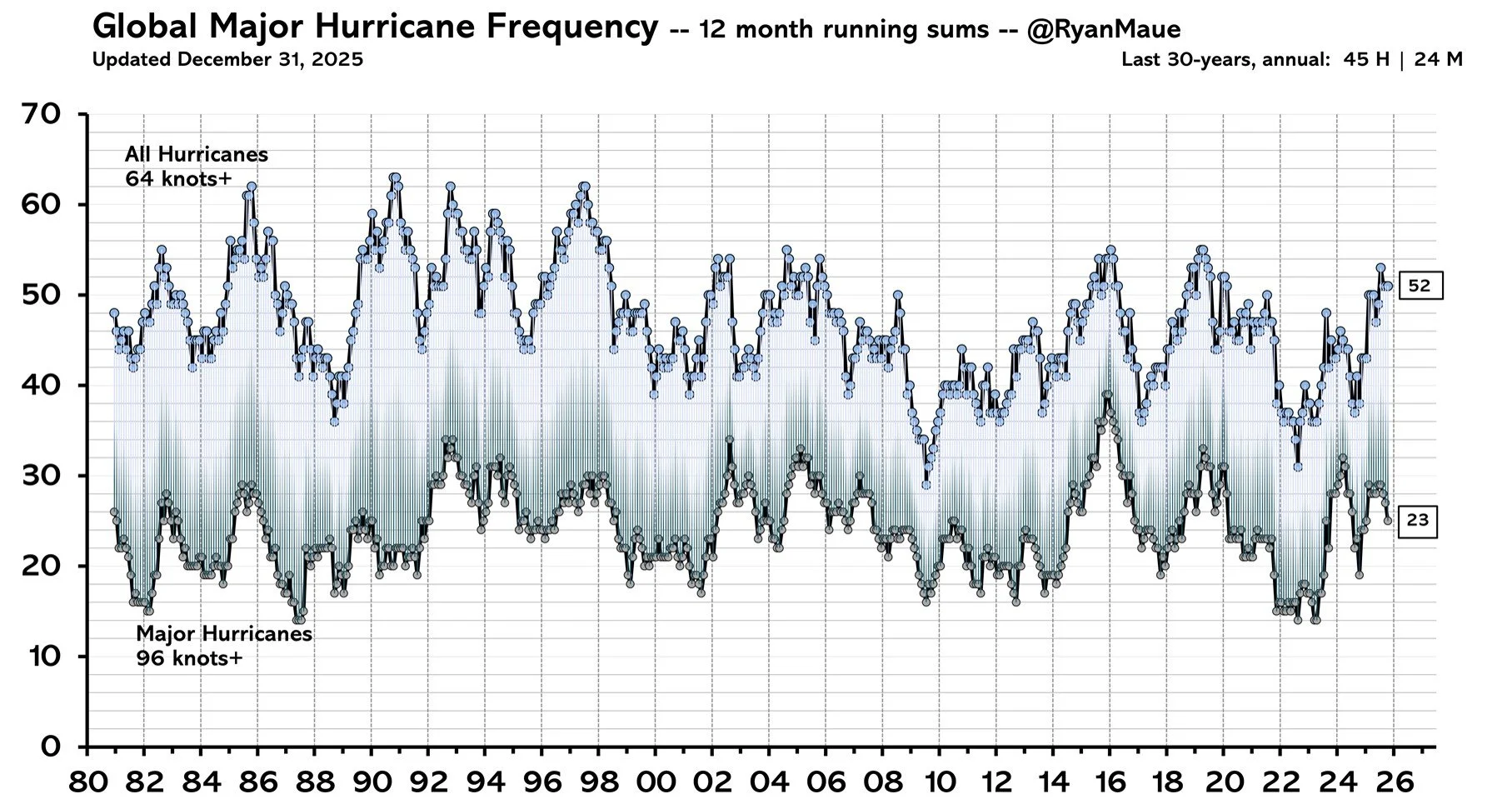
How often hurricanes have occurred globally since 1981 is depicted in the figure below. You can see that the frequency of hurricanes as a whole has slightly diminished on average over this period; major hurricanes show no apparent trend.
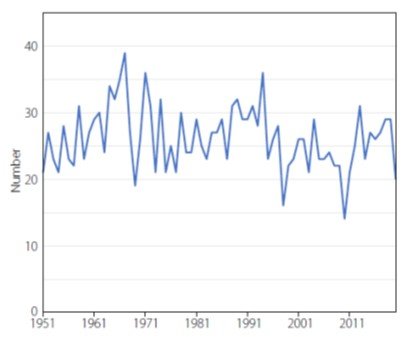
The next figure plots the frequency of typhoons since 1951, showing no trend. However, a 2022 study demonstrates a decline in both total and major typhoons for the 32-year period from 1990 to 2021. The same study reinforces the recent decrease in total global hurricanes seen in the first figure.
Data for the North Atlantic basin, which has the best quality data available in the world, during the period from 1851 to 2024 are shown in the following figure. It’s clear that hurricane frequency has been essentially unchanged since 1851. The apparent heightened activity over the last 20 years, particularly in 2005 and 2020, simply reflects improvements in observational capabilities since 1970, and is unlikely to be a true climate trend, say a team of hurricane experts.
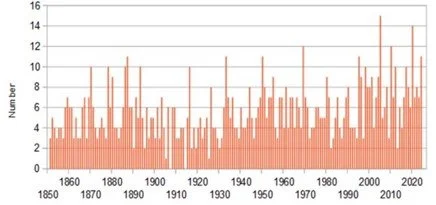
Aircraft reconnaissance flights to gather data on hurricanes only began in 1944, while satellite coverage dates only from the 1960s. The relative lack of observations in early years of the record reflects the fact that eyewitness accounts on land excluded most non-landfalling hurricanes, while reports from ships at sea were sporadic.
Another 2022 study reveals that tropical cyclones in general, which include hurricanes, typhoons and tropical storms, are letting up as the globe warms. Over the period from 1900 to 2012, the study authors found that the annual number of tropical cyclones declined by about 13% compared with the period between 1850 and 1900, when such powerful storms were actually on the rise.
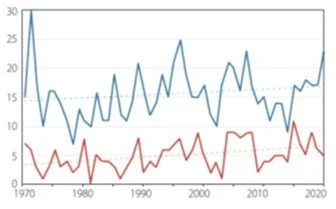
The lack of any long-term trend in global hurricanes and typhoons is borne out by the number of tropical cyclones that make landfall, illustrated in the next figure; the solid blue line represents all tropical cyclones, the solid red line major ones (Category 3, 4 or 5). The apparent slight uptick in both total and major landfalling tropical cyclones is statistically insignificant and could reflect the improvements in observation of North Atlantic hurricanes since 1970 mentioned above.
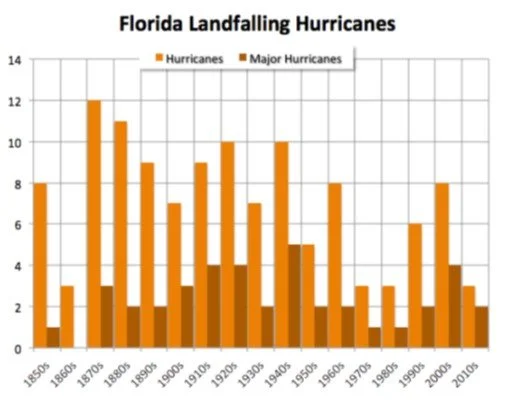
Finally, the figure below depicts the frequency by decade of all Florida landfalling hurricanes and major hurricanes since the 1850s. Florida has long been a favorite target of hurricanes. While there is no trend in major hurricanes over 170 years, the trend in hurricanes overall is downward – even in a warming world.
The downward trend in hurricanes and typhoons in general is somewhat counterintuitive, since one would think that higher sea surface temperatures combined with higher atmospheric moisture levels due to increased evaporation would provide extra fuel for cyclones. However, tropical cyclone formation is inhibited by wind shear, which also increases as sea surface temperatures rise.
The IPCC (Intergovernmental Panel on Climate Change) in its Sixth Assessment Report mentions two aspects of tropical cyclones that have been observed recently, namely more rapid intensification and slower forward speed. Both phenomena result in heavier rain following landfall. Nevertheless, the IPCC does not attribute them to global warming, and indeed their origins are not yet understood.
For Americans in and around the Gulf of Mexico, hurricanes have been a fact of life since Galveston and before. The death toll has fallen over time though, with improvements in planning and engineering to safeguard structures, and the development of early warning systems to allow evacuation of threatened communities.
Next: No Evidence That Weather Extremes Becoming More Frequent or Intense: (5) Tornadoes